
Finland dominates the global conversation about saunas, and rightly so — the country literally wrote the UNESCO entry on sauna culture. But the impulse to gather in a hot, enclosed space for physical and spiritual renewal is not Finnish. It is human. Civilizations across every inhabited continent developed their own versions of the sweat bath, independently and centuries apart.
The Mayan Temazcal: Womb of the Earth
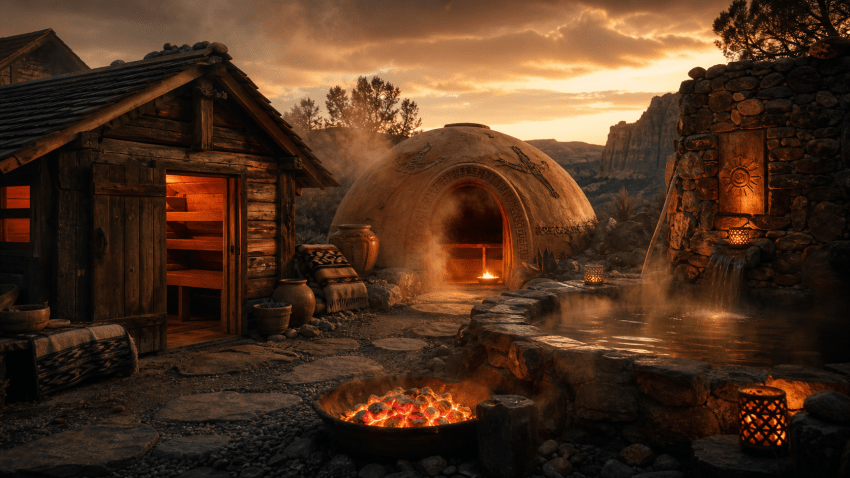
Long before European contact, Mesoamerican civilizations built temazcales — dome-shaped stone structures used for medicinal, ritualistic, and hygienic purposes. The word comes from Nahuatl: temazcalli, meaning “house of heat.” Red-hot volcanic stones were placed inside, and water infused with medicinal herbs was poured over them to create steam.
The temazcal was not merely a bathhouse. It was a sacred space presided over by a temazcalero — a healer who guided participants through a spiritual journey. The circular structure represented the womb of the earth goddess Toci, and emerging from the steam was symbolically equivalent to rebirth. Today, temazcal ceremonies survive in Mexico and Guatemala, though their deep medicinal logic is rarely discussed in mainstream wellness circles.
The Mongolian Sweat Yurt
Nomadic Mongolian culture developed a portable version of the sweat bath using their iconic ger (yurt) structures. Heated stones and aromatic herbs created intense steam inside the felt-lined tent. Mongolian traditional medicine used sweat bathing to treat joint pain, respiratory illness, and post-childbirth recovery — practices documented by Chinese physicians as early as the 13th century.
The Native American Inipi
The inipi, or sweat lodge ceremony, is one of the most sacred rituals among Lakota Sioux and many other Plains nations of North America. Unlike the Finnish sauna’s social informality, the inipi is deeply ceremonial — prayers, songs, and teachings are integral to the experience. Participants sit in complete darkness as a fire keeper heats stones called grandfathers outside and passes them in with a deer antler.
The ceremony is typically led by a knowledge keeper and represents purification of mind, body, and spirit. Crucially, the inipi is not a wellness trend — it is a living, protected cultural practice with strict protocols that outsiders are asked to approach with profound respect.
What Unites Them All
Despite arising on different continents, all indigenous heat bathing traditions share striking commonalities: communal participation, use of medicinal plants and minerals, integration of spiritual or ceremonial elements, and a deliberate alternation between heat and cold. Modern neuroscience is only beginning to understand why these elements work synergistically — the combination of heat, community, breathwork, and altered sensory states produces profound neurochemical shifts.
The world’s saunas are a map of human ingenuity. They show that long before medicine became clinical, our ancestors trusted heat, water, and community to heal what ailed them.